An exercise should stretch a skill the learner understands, not combine several unfamiliar demands at once.
Set a starting point
Ask the learner to explain one example without time pressure. If they cannot describe the method, teach it before assigning repeated questions.
Change one variable
For interval identification, begin with a familiar clef, a comfortable register and a small set of interval types. Broaden the set after the learner can distinguish those reliably.
For aural work, begin with a limited contrast such as same note, step and wider leap. Add more similar sounds as listening becomes more deliberate.
Check the actual settings
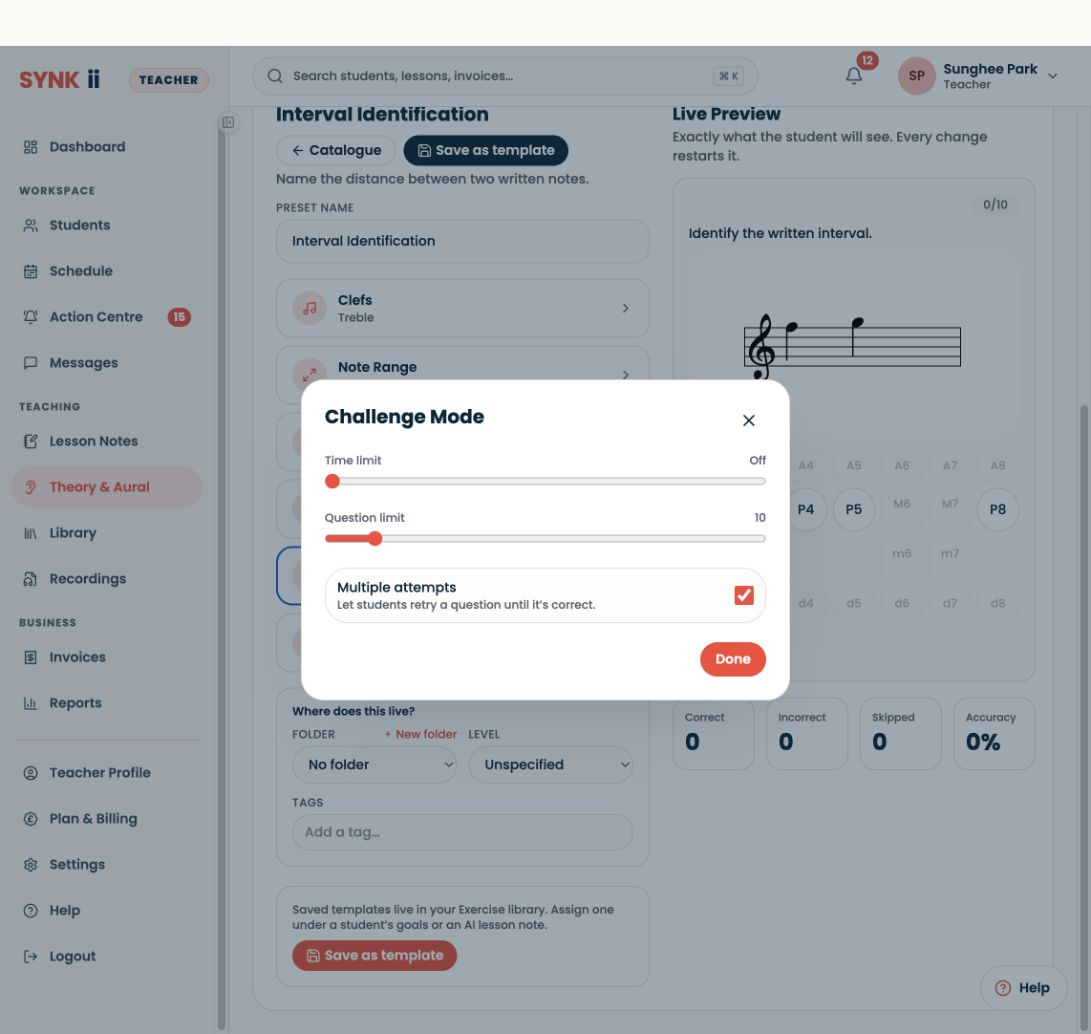
Read the question type, note range, timing and completion requirements in the exercise composer. Do not assume a previous exercise’s settings apply to the new one.
Watch the reasoning
A high score reached by guessing does not show the same understanding as a clear explanation. Ask the learner to justify one answer and connect it to a played example.
Respond to the result
If errors cluster around a concept, use a short teaching example before another run. If the learner is accurate but hesitant, repetition may help familiarity. If both accuracy and explanation are secure, broaden one aspect of the task.