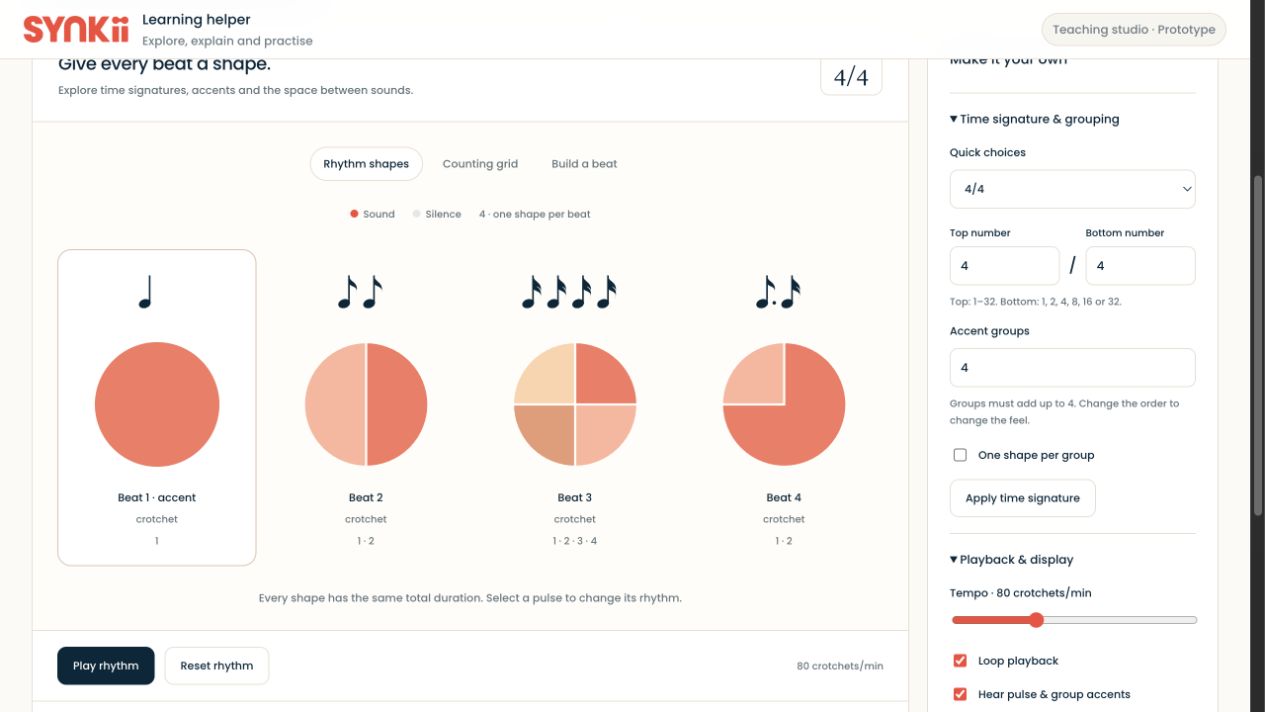
Teaching rhythm involves connecting what a student sees on the page with what they hear and perform. A student might recognise a quaver or semiquaver but still need help fitting those notes into a steady beat.
I created this free printable worksheet and companion video to give teachers a simple activity to use in lessons—and students something they can practise again at home.
The PDF follows the same 20 exercises as the video. Students can write the counts beneath each pattern, practise it, then scan the QR code to listen and check their rhythm.
Download the free rhythm worksheet
Watch the companion video on YouTube
What’s included?
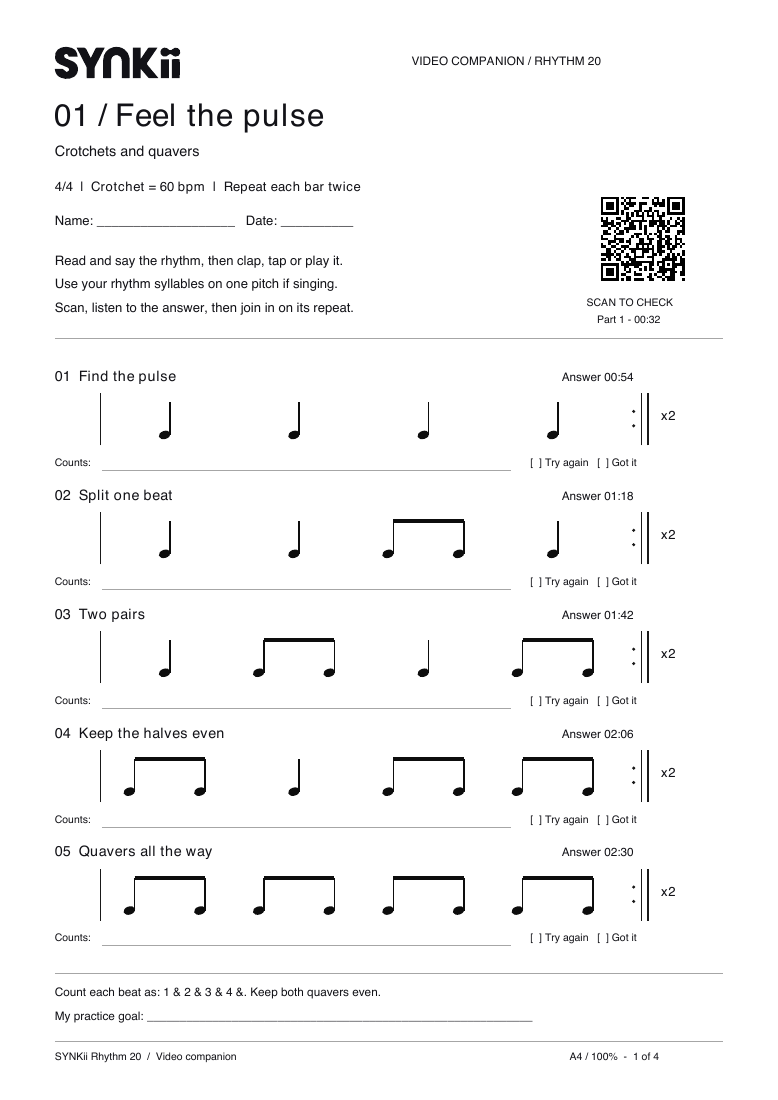
The exercises are all in 4/4 at 60 crotchet beats per minute, progressing through four sections:
- Feel the pulse: crotchets and quavers.
- Divide the beat: semiquavers and changing subdivisions.
- Long and short: dotted quaver–semiquaver patterns and their reverse.
- Put it together: mixed patterns using everything introduced earlier.
Each worksheet includes space to write counts, a practice checklist, and answer timestamps. The QR code opens the corresponding section of the video.
You can use the exercises for clapping, tapping, playing on one note, or rhythm solfeggio using the syllables you already teach.
A simple way to use the worksheet in a lesson
Start with one pattern and work through these steps at the student’s pace.
1. Establish the pulse
Before reading the notes, tap four steady beats together. Continue tapping while counting “1, 2, 3, 4”.
Keep that same pulse when the pattern introduces quicker notes. The quavers and semiquavers fit inside the beat.
2. Write and say the counts
Ask the student to write the counts underneath the notes before performing the pattern.
For quavers, use “1 & 2 & 3 & 4 &”. For semiquavers, subdivide each beat into “1 e & a”.
With dotted patterns, keep those four subdivisions in mind. A dotted quaver followed by a semiquaver begins on the beat number and sounds again on “a”. The reverse pattern sounds on the number and “e”.
If you teach rhythm syllables, use those instead—or alongside the written counts.
3. Perform the bar twice
Clap, tap, or speak the rhythm twice without pausing between repetitions. If you are singing, one comfortable pitch is enough to focus the activity on rhythm.
When a particular beat needs attention, practise that beat separately, then return it to the full bar.
4. Listen and compare
Scan the QR code to open the video section. Each exercise includes a four-beat count-in, two attempts at the bar, a short reflection period, and two answer repetitions.
Listen to the first answer, then join in on the second. Ask the student what they noticed: did the quavers stay even? Was the short note in the right place? Did the pulse remain steady?
The video provides a model to compare with their own performance.
Keep home practice small and specific
There’s no need to complete all 20 exercises at once. Choose two or three that suit the student and write down one clear goal, such as keeping semiquavers even or repeating a dotted pattern without rushing.
At home, students can read their counts, try the rhythm independently, then use the QR code to hear it again. The same notation and exercise numbers appear in both resources, making it straightforward to find the right example.
Download the free printable
Use the worksheet as a lesson warm-up, a rhythm-reading activity, or a short home-practice task.
Download the PDF and practise with the video
Make it your own with SYNKii
Create digital exercises within SYNKii and customise them for each student and occasion, whether you need a lesson warm-up, practice together in class or a focused task to take home. Adapt the content and difficulty to suit what each student is working on.
Try SYNKii free for 14 days and start creating exercises for your students.